
FRAVEye
The Next Generation of FRAVEye: What We Changed and Why
Nov 20, 2026 · Dominik Koníček
The first generation of FRAVEye gave us something that cannot be gained at a development desk: experience from real-world operation. It showed us what worked well, but also highlighted areas we would design differently today.
Those experiences became the starting point for the next generation of FRAVEye.
Rather than simply replacing a few components and calling it a new version, we went back to the individual parts of the device — the electronics, power management, mechanical design, camera, sticky trap handling, and image processing. Based on what we learned from FRAVEye 1.0 — from energy management and image quality to reliability, connectivity, maintenance, and ease of installation — we asked ourselves what we could improve.
The result keeps the same fundamental idea behind FRAVEye, but changes almost everything underneath.
From Off-the-Shelf Hardware to Our Own Electronics
The first FRAVEye was built around a straightforward goal: create a device capable of regularly photographing a sticky trap and sending those images for further processing. For early prototypes and validation of the concept, using readily available hardware components made sense.
As development progressed, however, we began to encounter their limitations.
The externally supplied hardware gave us limited room for the features we wanted to introduce over time. We also experienced reliability issues with one of the supplied components. The further we developed FRAVEye, the clearer it became that if we wanted full control over its future, we also needed control over the electronics inside it.
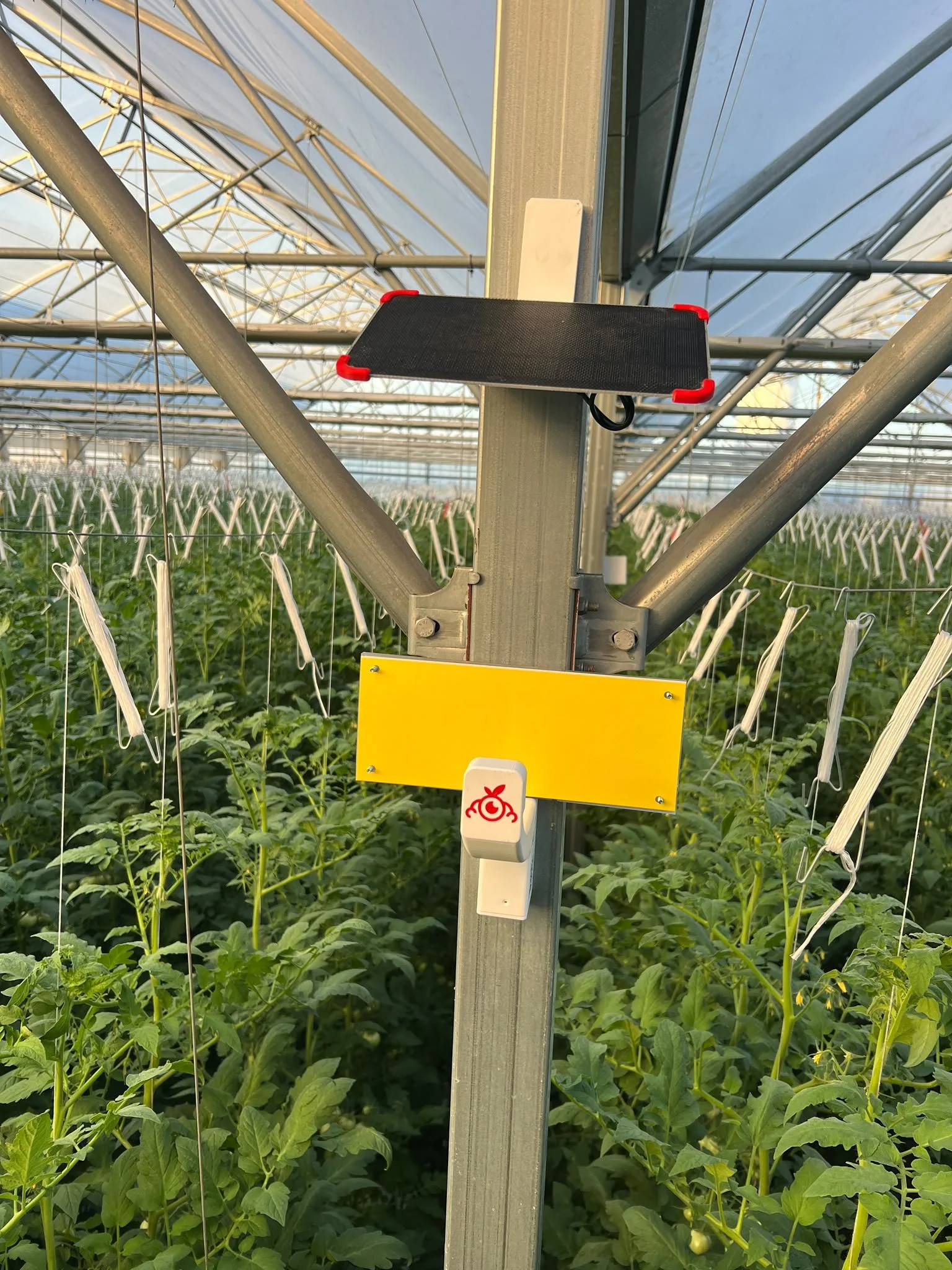
So we designed our own control board.
This is more than a replacement for the original solution. The new board was designed specifically around the requirements of FRAVEye, while also leaving room for additional components and features in future generations.
We also changed the placement of components and connectors. It may not be something users immediately notice, but it makes assembly easier, reduces unnecessary wiring, and gives us better control over the manufacturing and servicing process.
Most importantly, future development no longer has to be shaped around the limitations of third-party hardware.
Energy Matters When a Device Has to Work Autonomously
FRAVEye is designed to operate in greenhouse environments for long periods with minimal human intervention. Power management was therefore one of the key areas we focused on when developing the new electronics.
We redesigned the charging and power-management system. The new solution provides more reliable battery charging, generates less heat, and reduces the device’s own energy consumption.
But laboratory measurements alone were not enough.
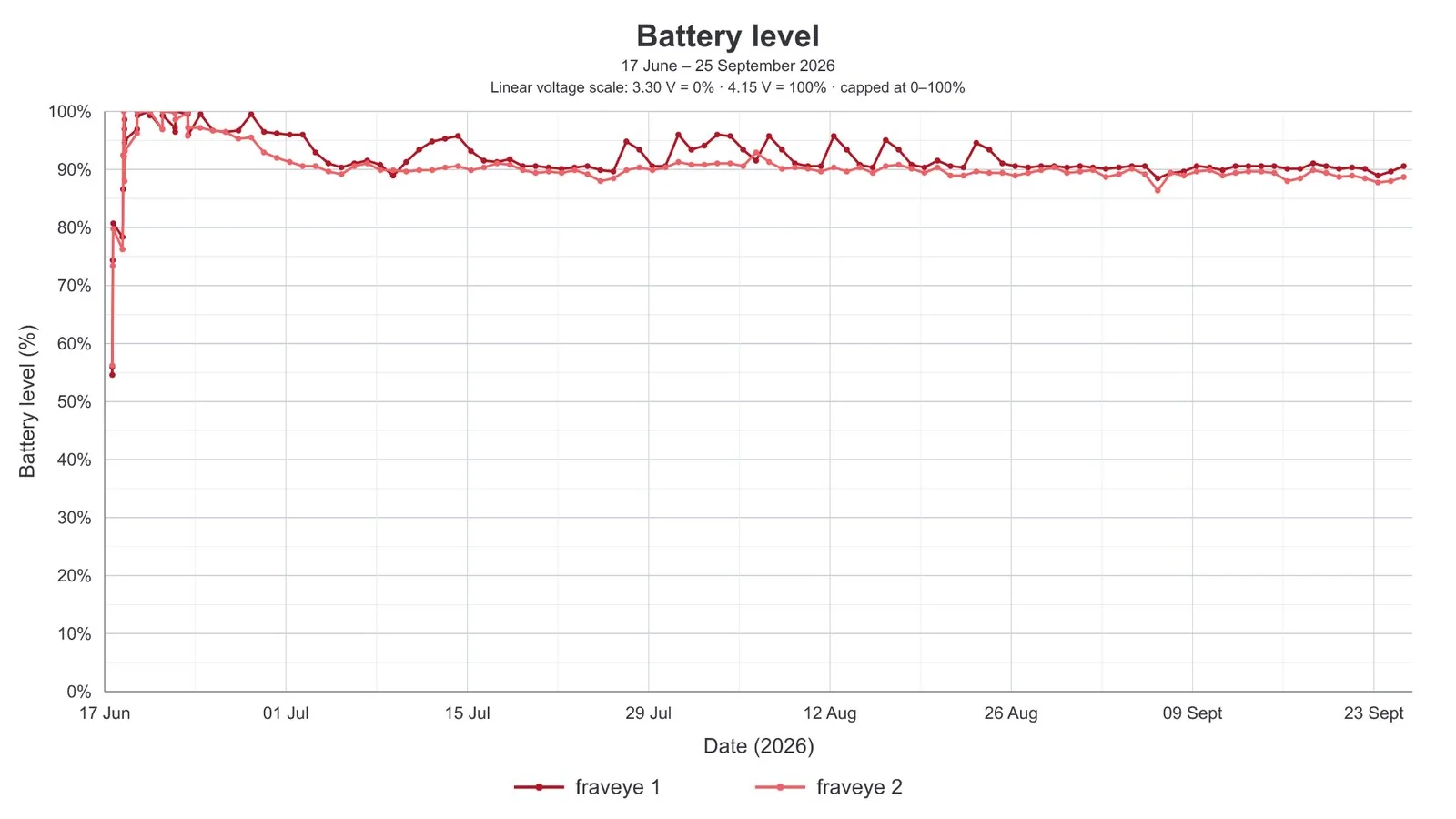
During the summer season, we continuously recorded battery levels on test devices and monitored how they behaved under real operating conditions. Long-term data like this helps us discover situations that may never appear during a short test on a workbench.
And summer is only part of the challenge. FRAVEye has to operate reliably throughout the year, including during winter months when available solar energy can be significantly lower. This becomes especially important as we aim to deploy FRAVEye globally, including regions such as Scandinavia, where winter solar radiation can be very limited.
Our goal is not to chase a single impressive battery-life figure. What matters more is stable and predictable operation under changing real-world conditions. Based on our testing, we estimate that FRAVEye could operate for approximately four months without solar charging when capturing one image per day. While actual battery life will depend on operating conditions, this gives us a useful baseline for designing the system around extended periods of limited sunlight.
And when solar charging is not enough, or conventional charging is simply more convenient, we have added USB-C. FRAVEye can therefore be charged using the same type of cable already found in almost every office, without requiring a dedicated charger.
Better Connectivity and Simpler Controls
A photograph only becomes useful once it reaches the system where it can be processed. That is why wireless communication was another important part of the redesign.
The new electronics include our own antenna designed specifically with the FRAVEye enclosure and internal layout in mind. The goal is to improve the radio characteristics of the device and provide a more reliable foundation for transferring images.
The two large buttons found on the side of the original device have been replaced by a single smaller button. We also moved the button and status LEDs to the bottom of the device, where they are better protected from direct exposure to water and moisture, helping improve the overall water resistance of the enclosure. At the same time, we redesigned the way FRAVEye communicates its current state during installation and operation.
The new version uses a more visible LED together with audible feedback, making it easier to understand whether the device is starting up, waiting for configuration, or performing an operation.
These may sound like small details on a specification sheet. But when installing or checking multiple devices, small improvements in usability quickly make a difference.
A New Sticky Trap System
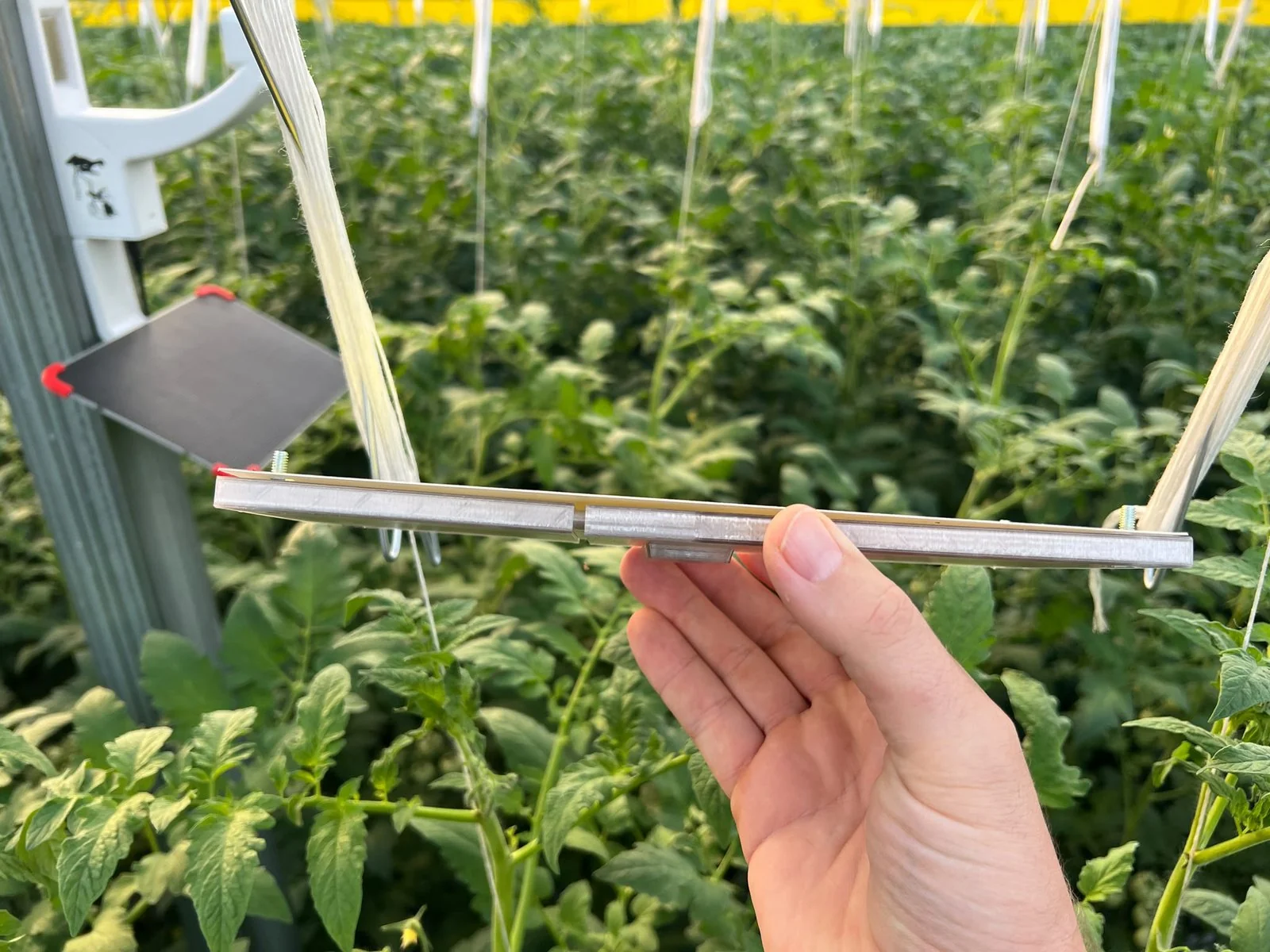
One of the most visible mechanical changes is the way the sticky trap is mounted.
In the first generation, the trap was inserted into a fixed structure. It worked, but replacing it was not as convenient as we wanted it to be.
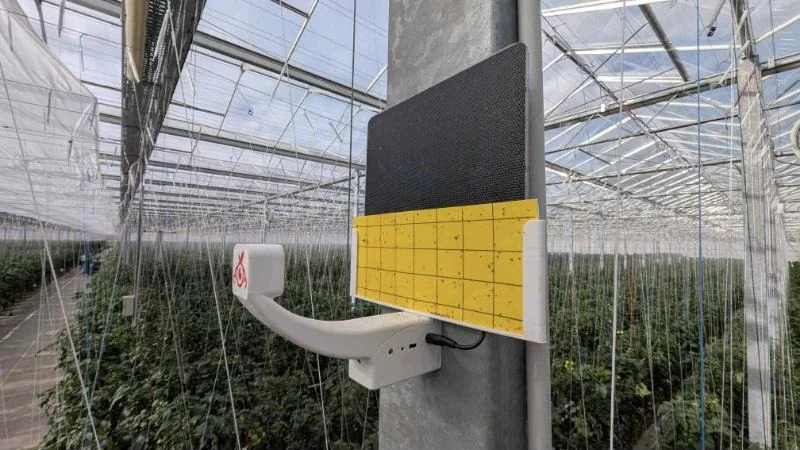
In the new generation, the entire section containing the photographed surface can be separated from the main body of FRAVEye. This provides much better access to the sticky trap and makes replacement easier.
But we took the mounting system a step further.
The sticky trap is now held at four points that apply tension towards the sides. This distributes the force more evenly and helps keep the photographed surface as flat as possible.
That matters not only for the photograph itself, but also for the computer vision systems that analyse it afterwards.
A Sticky Trap That Adapts to Temperature Changes
Conditions inside a greenhouse are never completely static. Materials heat up, cool down, expand, and contract throughout the day. Something that is perfectly tensioned in the morning may behave differently after several hours in direct sunlight.
We therefore added a spring mechanism inside the structure that continuously compensates for changes in the dimensions of the sticky trap.
Instead of fixing the trap rigidly in a single position, the system can partially adapt as conditions change throughout the day.
The goal is a more stable photographed surface — and a more stable input image means better conditions for everything that happens afterwards.
We Don’t Just Want to Detect Insects. We Want to Follow Them Over Time.
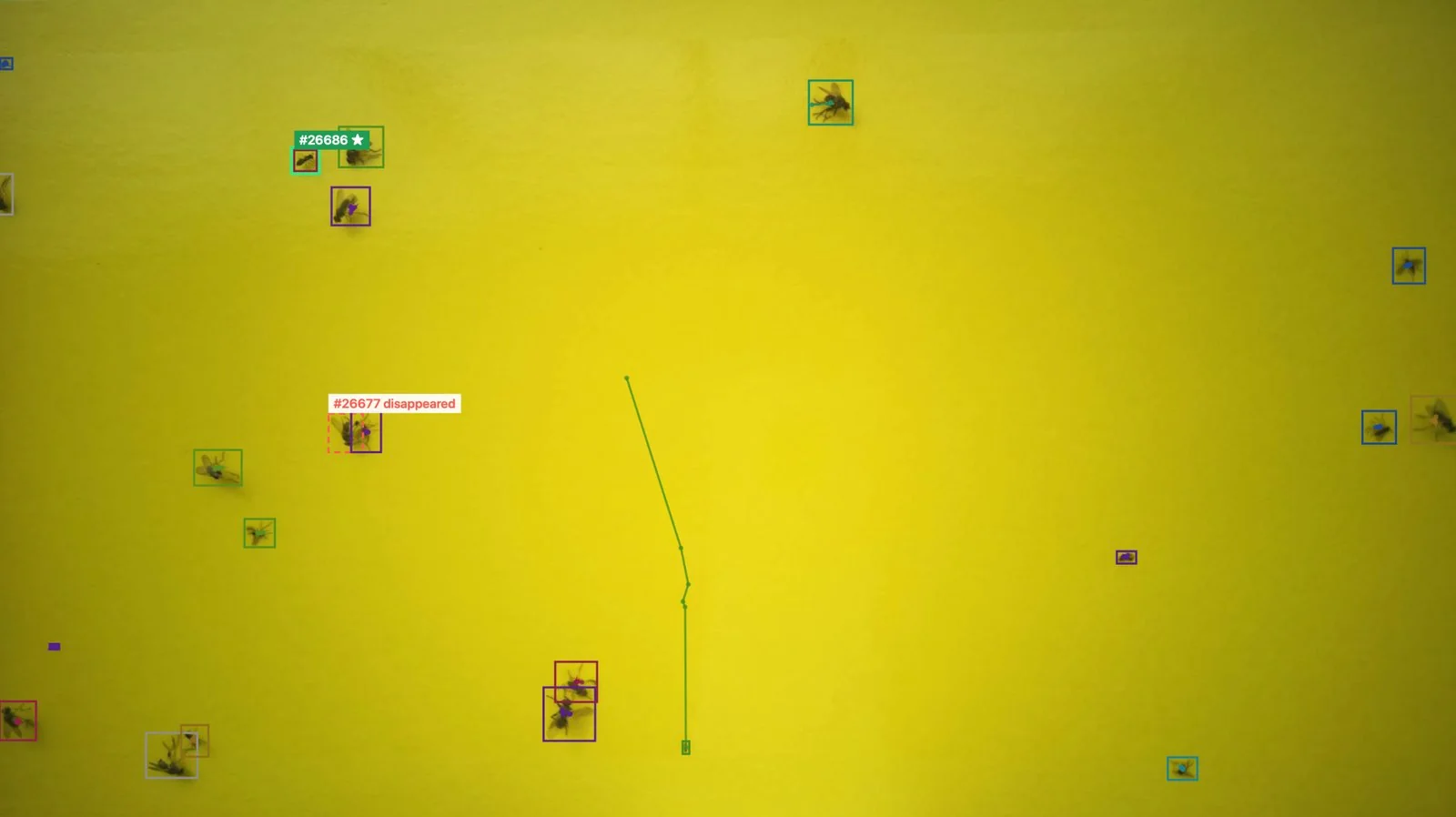
FRAVEye does not capture just a single image — it observes the same sticky trap repeatedly over time. We are now developing a tracking system that can take advantage of this.
The goal is to recognise which insects were already present and which ones have appeared since the previous image. This could provide more accurate information about new captures and pest development over time.
Tracking also gives our AI valuable temporal context, opening new possibilities for improving detection and classification in the future.
Instead of only asking “What is in this image?”, FRAVEye can begin to answer a more useful question:
“What has changed since the last image?”
The technology is still in development, but we believe it can become an important step towards more accurate and intelligent pest monitoring.
Getting Closer. Literally.
We have also changed the distance between the camera and the sticky trap.
The camera is now positioned closer to the photographed surface. As a result, individual insects occupy a larger area of the image, giving us more visual information for subsequent recognition and classification.
When dealing with very small insects, every pixel can matter.
But our work on image quality does not end with the optics. We are also experimenting with image-processing techniques that could make small details easier to inspect and analyse.
One of those experiments involves Real-ESRGAN, which we are testing for 2× image upscaling.
At first glance, the result can appear significantly sharper and small insects may be easier to inspect. But technologies like this need to be used carefully. During upscaling, the model reconstructs some image information and can potentially introduce structures that were not actually present in the original photograph.
For insect recognition, we do not want to confuse a visually sharper image with more accurate information.
We are therefore continuing to test and train Real-ESRGAN on our own images, with the aim of reducing unwanted visual artefacts while preserving the characteristics that matter for further analysis.
For now, this remains an experiment rather than a finished product feature. But experiments like these are an important part of finding ways to extract more useful information from every FRAVEye image.
The Next Generation Is Not About One Big Change
From the outside, FRAVEye may still look like a relatively simple device: a camera, a sticky trap, and some electronics.
Underneath, however, a lot has changed.
Our own control board gives us greater control over the electronics and future development. The redesigned power system is intended to reduce energy consumption and improve reliability. The new sticky trap mechanism makes replacement easier while helping maintain a more stable photographed surface. We have moved the camera closer to the insects. We are experimenting with new image-processing methods. And with tracking, we are beginning to look at photographs not simply as individual images, but as a time series showing how the sticky trap changes over time.
None of these changes were made simply so that we could call it a “new version.”
Each one addresses something we encountered during the development, manufacturing, or real-world operation of the first generation.
That is also how we want FRAVEye to continue evolving: test, measure, identify weak points, improve them, and test again.
For us, the new generation is above all a much stronger foundation for what we want FRAVEye to become in the years ahead.
And some of the most exciting parts are still being tested.
In upcoming articles, we will share more from behind the scenes — from testing the new electronics and comparing image quality to AI tracking and seeing how these improvements perform in real greenhouse conditions.